Window displays
For a luxury jeweller
- Client
- Pac Team Europa
- Where
- Milan · Rome
- Year
- 2024
- Disciplines
- Engineering, 3D, technical drawings
With Pac Team Europa, we brought an artist’s designs into the windows of a luxury jeweller in Milan and Rome: the shop rebuilt in 3D at full scale, every element designed to the millimetre so that it would fit together and actually work, then engineered to fit those spaces.
The shop’s constraints: 60 cm deep and no drilling
These are luxury shop windows, on Via Montenapoleone in Milan and Via Condotti in Rome. The display cases stay where they are, with the jewellery inside, and so do the fixed columns. There’s about 60 cm from the glass to the back, and the structure holding up the display takes 18 of those.
And the shop itself can’t be touched: not one hole, not one screw. The alarm sensors sit on the window frame. No piece may cover any of the jewellery. Everything has to fit through the gaps that remain: 37 cm between the columns, 17 between the frames of the cases.
From the survey to the shop in 3D, at full scale
The artwork is by an artist: illustrations created for the windows, to be carried across three different shopfronts in Milan and Rome.
From the survey I rebuilt the whole shop in 3D at full scale: the cases, the columns, the window frames and the alarms. On that model, together with the team, we made every element true to life so that it would actually work, from the backdrops to the animals, then engineered it for the space available. The detail went right down to millimetre tolerances, so that everything would fit together precisely and the display would work as a whole. Where there wasn’t enough depth, we split the illustration into layers, one behind the other. I modelled every piece in 3D with its real thickness. Then came the previews, to see each window before it was built.
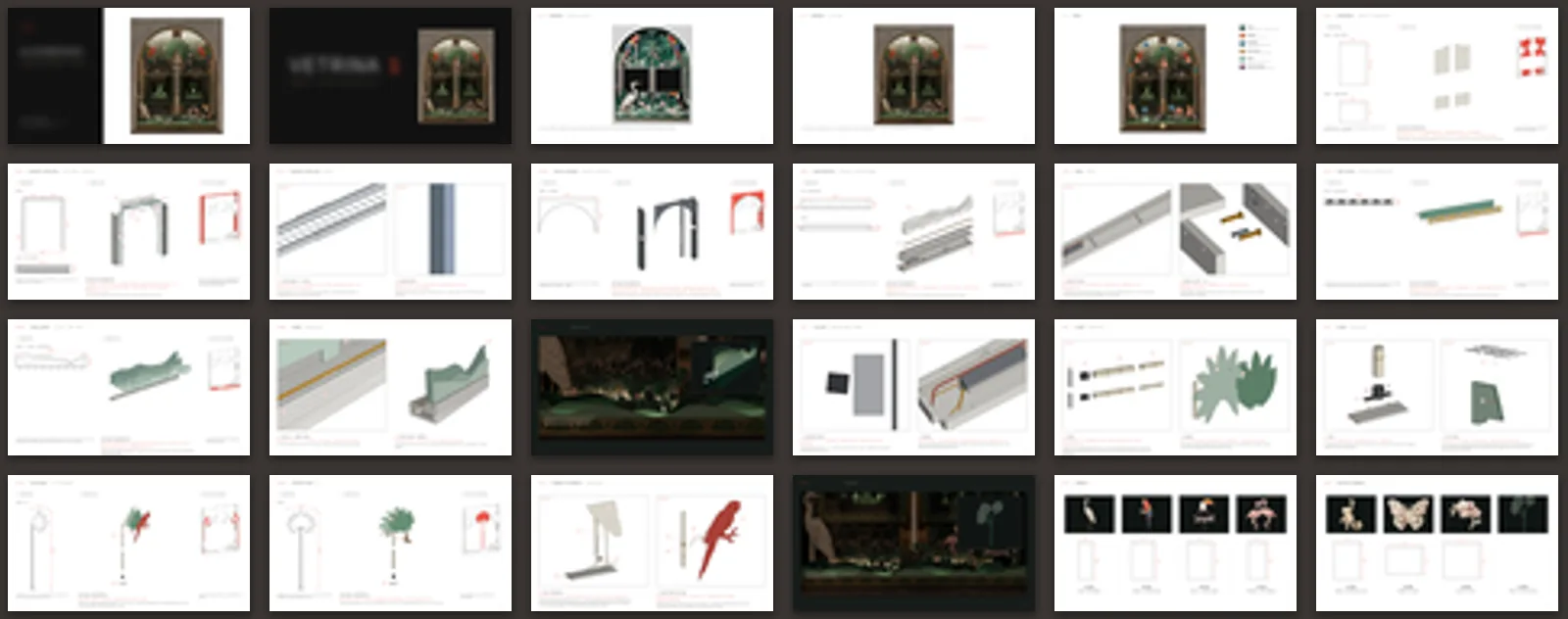
The window in exploded view, from the glass to the back
A window is built up in planes, from the glass to the back. Every piece has its own thickness, its own material and its own way of staying in place: printed 2 mm board and aluminium, 3 mm Forex that bends without breaking, UV adhesives that don’t yellow.
- 01FriezeRuns along the base, in front of everything.
- 02LayersAt the bottom, one behind the other, slotting into the base like a comb.
- 03BackdropsOn the columns, above and below the cases, held on with magnets.
- 04TreesIn the gaps between the columns, hung at the top from a welded mesh.
- 05Frame20×40 tube, bent into a C.
- 06BaseHouses the lights, the cables and the transformer.
Fixings: magnets and interlocking parts, no screws
We couldn’t drill into the shop, so every piece is held up with magnets, or with hook-and-loop or press-fit fixings.
The lower layers end in a comb, and the teeth slot into slits in the base, drawn to the millimetre. On Via Montenapoleone they’re in 2 mm board, which is more flexible, so they go in without warping. The backdrops attach to the columns with magnets, with a film over the metal so the finish doesn’t get marked. The 20×40 tube frame fixes to the window frame with hook-and-loop and bends into a C to clear the alarm sensors.
Some pieces were wider than the gap between the two fixed columns: we split them into parts that pass through the gap and are put back together inside the window.
The load has its own path too: the large pieces rest on the floor or on the cases, on lined plates that don’t mark them.
Window lighting, hidden in the base
The LED strips are hidden in the base, behind the frieze and the layers: they light the illustration from below. The cables and the transformer are inside the base too. The spotlights already in the shop are screened off.
What you can’t see is compliant too: the electrical components are CE and UL certified, and the materials comply with the EU REACH regulation.
Technical drawings and print-ready artwork: 175 drawings for seven windows
It’s a Pac Team Europa project; they build window displays, retail displays and exhibition stands, and I worked alongside their team on the engineering.
In Milan there were five windows, three on the street and two in the arcade, plus a large figure above the entrance. In Rome there were two. For this installation I produced 129 drawings for Milan and 46 for Rome, working from the artist’s files. Then I prepared 193 cutting files and 17 STEP models of the structures. The graphics are printed at full size: the frieze in one of the arcade windows is about 4.3 m long.
Every window follows the same structure: the artwork, the general arrangement, the index, then a drawing for each piece with its dimensions, exploded view and position, and finally the installation.
The maison’s technical team commented on the drawings one by one, and every request had to fit within the constraints. The flowers are made of 10 mm beads, the size of their track, so they couldn’t get any smaller than that. The trees had to stay lit, with 180 LEDs each. The figure outside had to withstand the weather: the silver print on the first sample was coming away, and Pac Team Europa redid it with a cold process. There were four rounds of samples in two weeks.
In Rome the survey arrived when the project was already under way, with some measurements still to be checked, and the alarm sensors in one window only came to light later: there too, the frame bends into a C to clear them.
The delivery dates were binding, with a penalty for any delay, and in December the figure above the entrance had to be revised as well. It was the second of three installations for this jeweller, between spring 2024 and spring 2025.
The finished display, in the evening
In the evening, from the street, the display wraps around the cases and the jewellery stays in full view.
To show the project, I redrew the artwork, the name on the sign and the images: the originals remain confidential. The shop’s measurements, the constraints and the technical work are those of the real project.